How to Repurpose One Article With AI Without Repeating Yourself
Turn an approved article into a newsletter, social post, and checklist while preserving facts and adapting each piece to its audience.
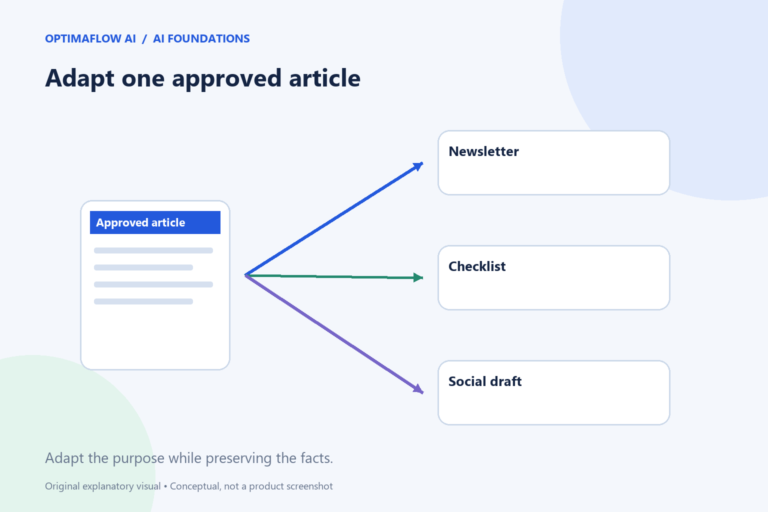
Repurposing is useful when a good idea needs different forms, not when the same paragraph needs more places to appear. AI can help create drafts from approved material, but each format should serve a different reader need. Start from a verified source article and give every derivative a clear purpose.
Choose the source and its limits
Select an article that has already passed factual review. Identify the main lesson, supporting evidence, and any conditions that must remain attached. If a time-saving example is fictional, every derivative that uses it must preserve that label.
Do not ask AI to invent fresh statistics or customer results to make the short version more persuasive. Record which parts of the source are suitable for reuse and which require the full explanation. A nuanced comparison may not fit responsibly into a one-sentence recommendation.
Give each format a distinct job
A newsletter can explain why the topic matters and direct readers to the full guide. A social post can introduce one specific mistake. A checklist can support someone applying the process. These are different outputs, even when they share source facts.
Write the audience, desired action, length, and tone for each format. For a workflow article, a newsletter might introduce human review, while a checklist lists approval steps. Repeating the introduction in all formats adds little value.
Use a constrained brief
Use only the approved article supplied below.
Draft a newsletter introduction for a small-business audience.
Focus on one practical decision and link to the full guide.
Preserve fictional-example labels and qualifications.
Do not add statistics, prices, testimonials, or new product claims.
Return a draft plus any questions about missing context.
The brief is illustrative. Supply the source through an approved method and check data permissions. Our brief builder can organize these instructions without sending them to an AI service.
Check the derivative against the source
Read each claim beside the original. Look for stronger language, omitted conditions, and new assertions. A short post that changes “may reduce handling time” to “cuts work in half” has changed the claim rather than summarized it.
Then review the format itself. Does the newsletter have a clear next step? Does the checklist use observable actions? Does the social post make sense without the missing paragraphs? A faithful summary can still be unhelpful if it depends on context the reader never sees.
Publish with a reuse record
Keep the source URL and version with each derivative. If the source is corrected, identify the related pieces that may need revision. Avoid mass-posting near-identical text to create the appearance of a larger library.
Measure whether readers use the derivative for its intended purpose. Clicks alone do not show that a checklist helped someone complete the task. Combine this process with our fact-checking workflow and approval checklist.
Example: three useful derivatives
Take an approved guide about review checkpoints. A newsletter introduces why sending is different from drafting. A social post highlights the mistake of treating a successful tool response as proof of publication. A checklist lists the saved-page checks before approval.
All three share the source, but their reader jobs differ. Verify that the newsletter preserves the limitation, the post does not exaggerate the risk, and the checklist names actions a person can perform. Keep the original guide linked where a shorter format omits necessary explanation.
A reuse mistake
Do not turn a fictional example into an implied customer success story in the shorter version. Labels and qualifications need to travel with the reused claim.
Frequently asked questions
Can AI create every format in one request?
It can draft several, but review their distinct purposes and factual fidelity separately. One batch response is not one completed editorial review.
Should I publish the same text on every channel?
Only when it suits each context. Usually a clearer audience-specific purpose makes the derivative more useful.