When Should an AI Assistant Retrieve Knowledge Before Answering?
Understand when a support assistant needs approved knowledge retrieval, how to prepare sources, and how to handle missing answers.
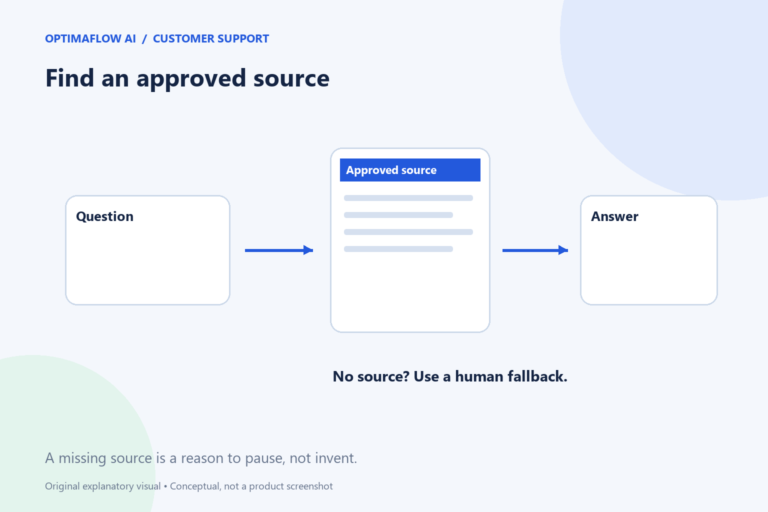
An assistant answering business-specific questions needs a reliable way to use your approved information. Retrieval means selecting relevant material before generating a response. It can help with current policies and product details, but it does not guarantee that the selected material is correct or that the final answer follows it.
Identify questions that require business facts
General writing assistance and policy answers are different tasks. A request to rewrite a greeting may not need a knowledge system. A question about refunds, availability, or delivery terms needs the business’s actual approved information.
List the common question types and the source that should answer each. If no authoritative source exists, create or clarify it before building the assistant. Searching a folder of inconsistent documents can produce an answer without resolving which policy is current.
Prepare a small approved library
Use clearly titled documents with owners, review dates, and scoped topics. Keep outdated versions distinguishable from active guidance. Break up long mixed-purpose material where that makes the intended answer easier to find, without removing important qualifications.
A source should state who and what the policy applies to. For example, a delivery rule may differ by region or product. Retrieval that finds the rule but loses its conditions can mislead the user. Test whether those qualifications remain in the retrieved context.
Inspect the retrieved material
Separate retrieval quality from answer quality. First ask whether the system selected the right document and passage. Then check whether the assistant accurately used it. If the wrong material was selected, adding more response instructions may not solve the underlying problem.
Keep a source identifier with the answer for internal review, and provide appropriate references to users when useful. A source label is not proof by itself: verify that the referenced passage supports the actual claim.
Handle gaps and conflicts explicitly
Write a response rule for missing knowledge. The assistant might ask one clarifying question or route the request to a person. It should not fill a policy gap using generic assumptions about how businesses usually operate.
For conflicting sources, identify the policy owner and pause the affected answer type until the conflict is resolved. A confidence score does not decide which business rule is authoritative. Keep the original question and relevant context available for the human handoff.
Maintain the sources with the workflow
Assign responsibility for updating the library when policies change. Test a few affected questions after each important update, including exceptions. Remove stale material from the active retrieval set according to the system’s supported process rather than merely changing a filename.
Start with our knowledge-base checklist and handoff guide. A smaller, maintained library is often more useful than a large collection with unclear ownership.
Example: a policy with an exception
A knowledge source says a service is available on weekdays, with a separate exception for public holidays. A question asks whether a particular holiday is covered. Retrieving only the first sentence would produce an incomplete answer. The relevant context needs the exception and a way to check the specific date.
If the source does not resolve that date, route the question rather than assuming normal weekday coverage. Record the gap for the policy owner. Improving the library can be the right repair; making the assistant sound more confident cannot supply the missing business fact.
Do not confuse quantity with coverage
A large document collection may still lack the answer. Coverage means authoritative information for the relevant question and conditions, not merely many pages available to search.
Frequently asked questions
Does retrieval eliminate hallucinations?
No. It provides context, but selection, interpretation, and generation can still fail. Validate important answers and keep a fallback.
Should every internal document be searchable?
Only include material that is authorized and relevant to the assistant’s scope. Apply access rules and minimize unnecessary data.