A Fact-Checking Workflow for AI-Generated Articles
Check claims, sources, examples, and dates in AI-generated drafts before publishing. Use a claim ledger and a focused review pass.
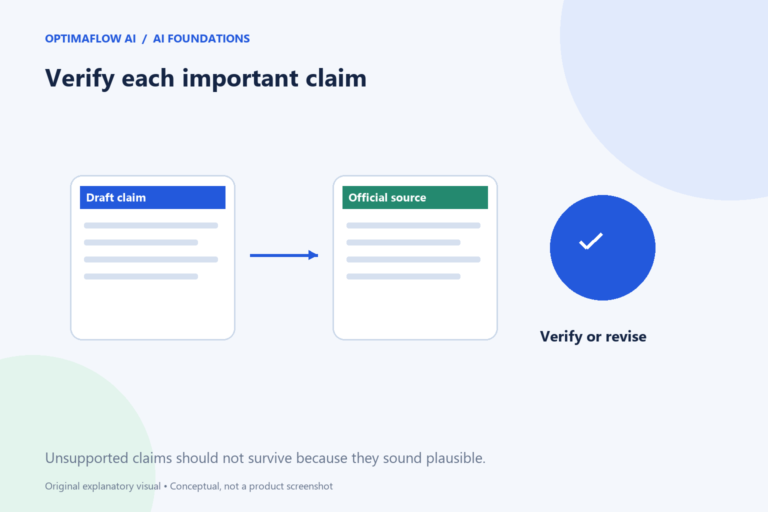
AI-generated prose can make an unsupported statement sound settled. A publication workflow needs a separate fact-checking stage that asks where each claim came from. This guide explains a practical review process for informational articles, including how to handle missing evidence without filling the gap with plausible wording.
Make a claim ledger
Read the draft and list the statements a reader could verify: a feature, price, release date, statistic, quotation, or product limitation. Record the statement, source URL, relevant passage, and review date. A long article does not need a citation after every general explanation, but specific assertions need a traceable basis.
Prioritize claims that could affect a decision. A wrong price or permission requirement may matter more than a minor wording issue. Mark each claim as supported, needs revision, or remove. Do not leave uncertain claims hidden inside a paragraph that otherwise reads well.
Open the original source
A citation can point to a real page that does not support the sentence. Read the relevant section, check the publication context, and confirm that it applies to the product or plan being discussed. Prefer official documentation for current software behavior and primary research for research claims.
Look for qualifications. A feature may require a paid plan, administrator permission, or a particular region. Preserve those conditions in the article. Avoid turning “can” into “always,” or a vendor’s demonstration into evidence that every user will get the same outcome.
Separate examples from evidence
A fictional business scenario can explain a calculation without becoming a case study. Label it clearly and show the inputs. For time-saving examples, include review and maintenance rather than reporting only the AI response time. Check the arithmetic independently.
Do not invent testimonials, screenshots, expert identities, or test results to make a guide look more authoritative. Conceptual images should be captioned as illustrations. If a product was tested, say what action was performed, in what environment, and what the test does not establish.
Run a currentness and language pass
Review prices, user interfaces, product names, and setup requirements close to publication. Link current official instructions rather than implying a static screenshot will stay accurate. If a fact cannot be checked, omit it or state the uncertainty honestly.
Then inspect the verbs and qualifiers. “Guarantees approval,” “eliminates errors,” and “best for everyone” require stronger evidence than most guides have. Replace broad promises with observable behavior and concrete limitations. This improves usefulness as well as credibility.
Keep a review record
Save the claim ledger with the draft. Record substantial changes and sources so future updates are easier. A publication date is not a substitute for a review date, and a new date should not imply verification that never happened.
For your next article, check five decision-relevant claims before polishing the introduction. Use our content approval checklist for the final pass and our editorial policy for disclosure standards.
Example: checking a time-saving claim
A draft says a process “saves eight hours every month.” The underlying fictional calculation covers 100 tasks with five minutes saved per task: 8.33 hours before maintenance. If two maintenance hours remain, recovered capacity is 6.33 hours. The stronger sentence omits an important cost of the process.
Correct the arithmetic and label the example. If the draft also implies a reduction in payroll, remove that implication unless evidence supports it. Time recovered can be used for other work without creating cash savings. The review should preserve that distinction in the title, summary, and image caption, not only in a small disclaimer.
A source-checking trap
Do not accept a real URL as proof. A source might discuss a different plan, region, or use case. Read the relevant passage and preserve the conditions that make the claim true.
Frequently asked questions
Does a plagiarism score prove accuracy?
No. Original wording can still contain false claims. Check originality and factual support as different questions.
What if official sources disagree?
Describe the conflict and date the sources. Avoid presenting a single confident answer until the difference is resolved.