A Practical Approval Checklist Before Publishing AI-Assisted Content
Review purpose, facts, originality, images, links, and page rendering before publishing an AI-assisted WordPress article.
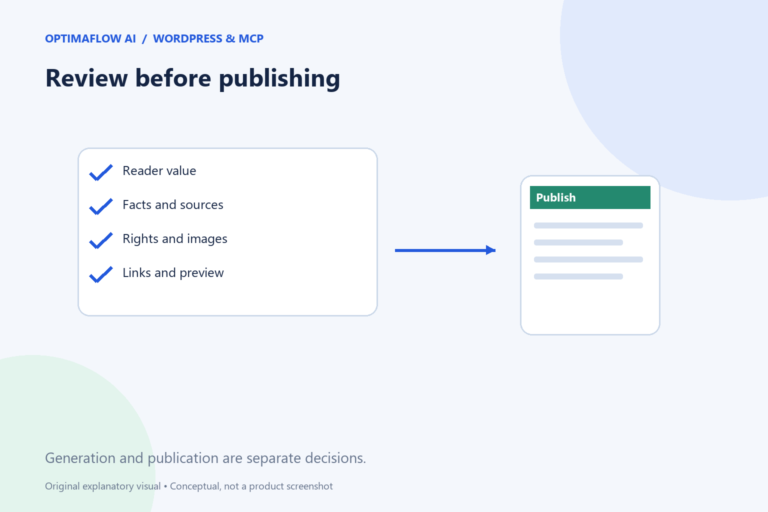
A content approval checklist gives the final reviewer a concrete job. It is especially useful when AI helps draft the article, because attractive prose can conceal unsupported claims and repetitive sections. Approval should cover both what the article says and how the actual page works for a reader.
Check the reader’s task
Write the question the article answers in one sentence. Confirm that the introduction and main sections address it directly. A page about choosing a first automation should help someone choose, rather than repeating a general description of AI.
Look for a practical next step, relevant examples, and meaningful limitations. Remove sections that exist only to increase length. Compare similar articles on your own site so the new piece does not duplicate their purpose under a different title.
Review facts and originality
Use a claim ledger for prices, features, statistics, quotations, and tested behavior. Open the sources and confirm the qualifications. Label fictional scenarios and avoid unsupported superiority claims or promises about rankings and approval.
Originality includes the contribution, not merely different wording. Rewriting another article sentence by sentence does not establish a useful new explanation. Add your own task-specific structure, reasoned examples, and transparent checks. If a quotation is necessary, keep it appropriately limited and attributed.
Inspect images and links
Confirm that the cover belongs to this article and supports its topic. Provide concise alt text for meaningful images and a caption when readers might mistake a concept diagram for a product screenshot. Check rights and disclosures for externally supplied assets.
Open internal links and confirm their destinations. Anchor text should tell readers what they will find. Avoid a chain of repeated “click here” links. Official documentation links should support the nearby claim rather than serving as a decorative source list.
Preview the saved WordPress page
Check the actual title, heading hierarchy, table layout, paragraphs, and mobile navigation. A draft can be correct while its page template shows a duplicate heading, oversized image, or broken shortcode. Test the article’s tool links and FAQs on the saved page.
Review the canonical URL and indexing directives when you have suitable access. A valid page still may not be indexed immediately. Ensure that the page belongs in the guide directory and sitemap so readers and crawlers can discover it naturally.
Record the final decision
Approve, request specific revisions, or hold the article. Record unresolved concerns and assign them rather than treating a partially checked draft as published-quality material. The publisher remains responsible for deciding whether the content is ready.
For connected publishing, follow our draft-first workflow. Pair this final checklist with fact checking and the editorial policy. A checklist is useful only when the reviewer actually performs the checks.
Example: a page that needs revision
The saved article has a readable draft, but the live template shows two main headings and its calculator link points to an obsolete page anchor. Approval should identify both issues. Correct the template and link, then inspect the saved page again.
The same review finds an example described as “tested” even though it is fictional. Change that claim and its caption. These are different problems: presentation, navigation, and evidence. A single generic checkmark for “SEO ready” would hide what the reviewer actually verified.
Do not approve by appearance alone
A professional design can make weak content look convincing. Treat layout quality and factual quality as separate checks, both necessary for the intended reader experience.
Frequently asked questions
Does completing the checklist guarantee AdSense approval?
No. Google reviews the site under its current policies and makes its own decision. A checklist helps identify problems; it cannot guarantee approval.
Should I publish first and fix everything later?
For factual or consequential issues, review before publication. Small presentation improvements can follow, but they do not excuse known inaccurate content.