How to Use AI for Email Triage With a Human Review Queue
Sort email by explicit purpose, preserve the original message, and route uncertain or sensitive cases to a reviewer before taking action.
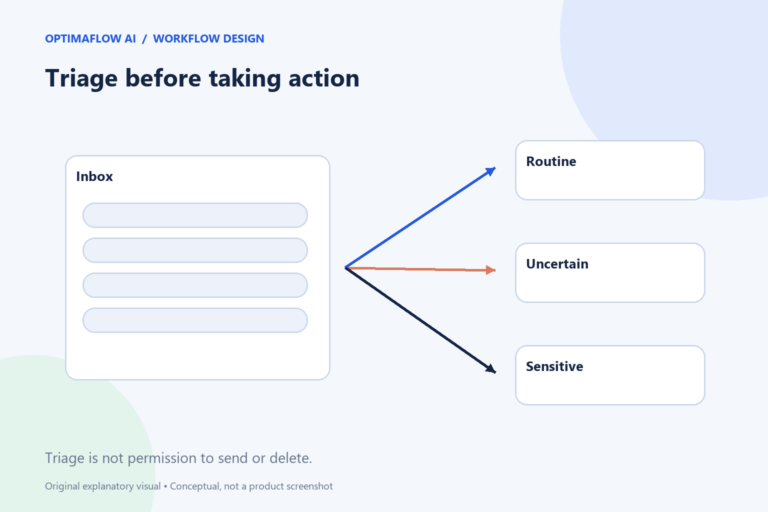
Email triage is the first sorting step, not the final decision about what a message deserves. AI can suggest categories and summaries for varied text, but it should not quietly send replies, discard important messages, or infer sensitive facts. Design a queue that makes uncertain cases visible to a person.
Define a small category set
Choose categories that lead to a useful next action, such as service enquiry, support request, billing question, or needs review. Avoid a long list with overlapping meanings. Write examples and exclusions for each category.
For a fictional small business, “support request” could mean a question about an existing service, while a new project request belongs in enquiries. An ambiguous message should not be forced into the closest label merely to complete the field.
Check data access and scope
Limit the workflow to the intended mailbox or folder. Review whether messages can be processed by the selected service and remove unnecessary fields where possible. Emails may contain attachments, secrets, or personal information that the triage step does not need.
Start with fictional samples or approved anonymized material. Do not connect an entire mailbox before the category scheme and review process have been tested. Access should fit the specific task.
Ask for a concise suggestion
The output can include category, short summary, reason, and review flag. Require the summary to preserve requests and constraints rather than infer intentions from tone. Keep the original message accessible to the reviewer.
Do not combine triage with an automatic substantive reply in the first pilot. Sorting and committing to a customer are different actions. A suggested category can be corrected easily; an incorrect promise may be harder to undo.
Route uncertain and consequential messages
Create explicit handling for ambiguous, sensitive, urgent, or out-of-scope content. The rule should identify the responsible role and the information provided to them. Avoid silently dropping messages that do not match the ordinary categories.
Review how the system handles quoted conversations and embedded instructions. Message content is data for the triage task, not authorization to change the workflow or reveal other messages. Keep tool permissions and approved actions separate from what the email says.
Measure review and correction
Track category corrections, missed important requests, reviewer time, and queue delay. Compare the process with manual triage. A high percentage of labeled messages is not useful if the important exceptions are buried.
Use the time calculator to estimate capacity, then compare with observed results. Pair this guide with data handling and structured output before expanding into replies or record changes.
Example: an email with two purposes
A message asks about a new project and also reports a problem with an existing service. A single forced category could hide one request. The workflow can mark needs-review or use a documented multi-category rule, depending on how the business handles mixed messages.
The reviewer should see the original and a concise summary of both purposes. Sending a generic sales response automatically could overlook the support issue. This is why a sorting pilot should keep substantive replies separate from the category suggestion.
Do not measure labels alone
A high classification rate says little about missed important requests. Review the correction rate and the consequences of incorrect routing, including queue delays.
Frequently asked questions
Can the workflow delete messages classified as irrelevant?
Keep deletion separate and reviewed, especially during a pilot. A mistaken category should not cause irreversible loss.
Should urgency be inferred from tone?
Use explicit criteria and source evidence. Tone alone can be misleading, and important messages may be written calmly.