How to Prepare a Knowledge Base for an AI Support Assistant
Organize approved support answers with ownership, scope, exceptions, and review dates before connecting an AI assistant.
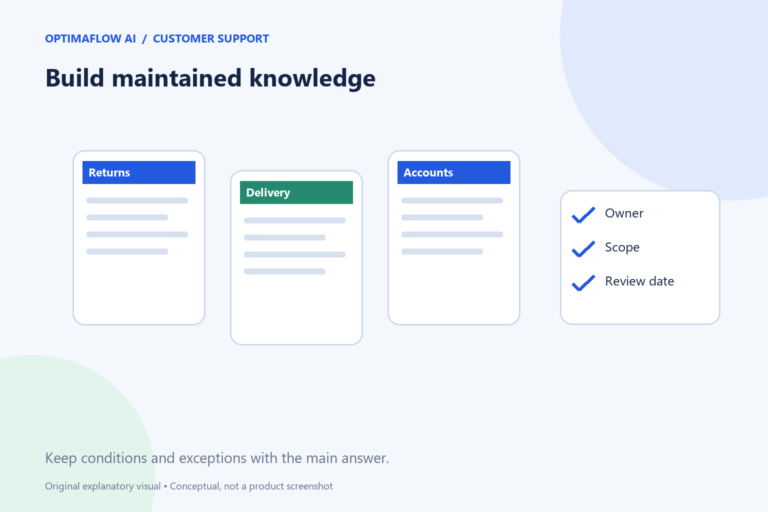
A support assistant cannot compensate for unclear business knowledge. If the source library contains conflicting policies, missing conditions, and stale answers, retrieval may simply make those problems easier to repeat. Preparing the knowledge base is an editorial and operational task before it is an AI integration task.
Start with the support queue
Group common questions from authorized, appropriately handled records. Identify the information needed to answer them, not just the phrases people use. A delivery question may depend on region, product, and order status.
Separate general help from account-specific actions. Public instructions can explain a process, while changing an order may require authenticated access and a person. A knowledge article should not imply that the assistant can perform actions it is not equipped or authorized to take.
Create a clear source format
Use a title, short answer, applicability, steps, exceptions, owner, and review date. Keep related conditions in the same source where practical. A refund answer without the eligibility conditions is incomplete.
Write plainly and avoid vague internal shorthand. If a policy needs interpretation, state who resolves it. Do not publish a fabricated answer merely to eliminate an “unknown” response from the assistant.
Resolve conflicting versions
Choose the authoritative active source and clearly separate archived material. A file with a newer filename is not necessarily approved. Record who made the decision and when the policy took effect.
After changing a source, confirm how the connected retrieval system refreshes its index. Updating a document does not prove that every cached or indexed copy changed immediately. Test the affected questions through the actual assistant.
Build a question test set
Include ordinary questions, incomplete questions, exceptions, and requests outside the business’s scope. Compare the retrieved source and final answer separately. If the correct source is retrieved but its conditions disappear in the response, the answer still fails.
Test handoff behavior when the library has no answer. The assistant should explain the limit and route the request appropriately. A useful test includes what the human receives, not just what the visitor sees.
Assign maintenance ownership
Link policy updates to source review. When the business changes a service or delivery rule, identify which knowledge articles and test questions are affected. Keep a correction process for support staff to flag inaccurate answers.
Start with a small maintained library rather than importing every document. Use our retrieval guide and handoff checklist to connect the source library with a controlled support process.
Example: separate general and account help
A public article explains how to request a billing correction. An account-specific question asks whether a particular charge has been reversed. The assistant can use the public steps, but confirming the charge requires appropriate access and an authorized process.
The source library should make this boundary explicit. A helpful answer explains the next step and handoff instead of implying that the public article proves the account status. Test both question types when checking the assistant.
A stale-source warning
Moving an old document into an archive folder may not remove it from an existing retrieval index. Confirm the system’s refresh and removal behavior, then test the affected answers.
Frequently asked questions
Should the knowledge base contain marketing claims?
Only approved, support-relevant information. Promotional wording can obscure conditions that a support answer needs to explain clearly.
How often should sources be reviewed?
Review when policies change and on a schedule suited to the business. High-change or consequential topics deserve closer attention.