How to Test an AI Prompt Before Using It in a Workflow
Create a small prompt test set, compare outputs, and record failures before using AI-generated text in a business workflow.
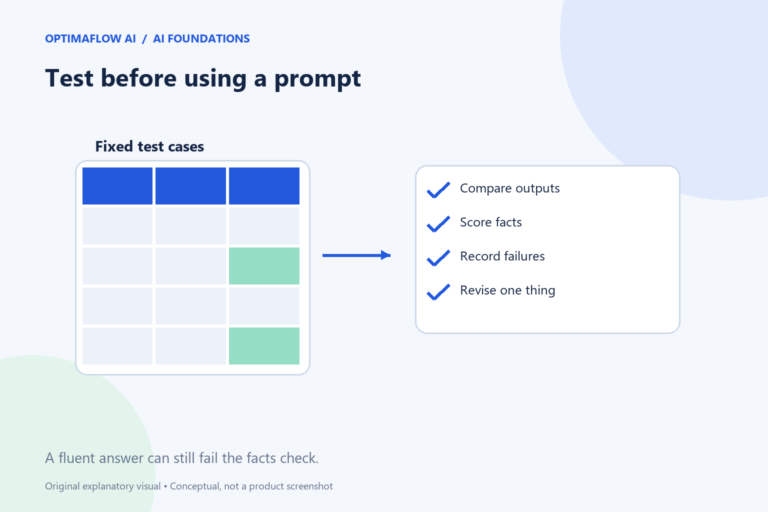
One impressive answer is not enough to evaluate a prompt. A useful test asks whether the instructions work across the kinds of inputs your process actually receives. The goal is a repeatable review method, not proof that an AI model will always behave the same way.
Write the requirements first
Define what a correct result contains and what it must avoid. For an enquiry summary, requirements could include the requested service, stated deadline, and missing information. Prohibited behavior could include inventing a budget or promising availability. “Sounds good” is too vague to be a reliable test.
Create a review sheet before trying the prompt. Use separate checks for factual accuracy, required fields, format, and unsupported claims. A polished answer can pass the tone check and fail the facts check. Keeping those scores separate makes a weakness visible rather than averaging it away.
Build a representative sample
Start with fictional or appropriately anonymized examples. Include a short ordinary request, a long request, missing fields, contradictory statements, and irrelevant instructions embedded in the text. Do not place private customer records in a new service merely to make the test realistic.
Write an expected result for each example. For ambiguous input, the expected behavior may be “ask for clarification.” That is a valid output. A test set containing only well-written inputs rewards a prompt that succeeds in a demonstration and struggles with the real queue.
Review evidence rather than fluency
Compare each output with the source. Highlight every factual statement and identify where it came from. If the summary says “urgent,” check whether the original message supports that interpretation. If it adds a deadline, it fails even when the rest is useful.
Record the reviewer’s correction and its impact. A formatting issue differs from a false commitment to a customer. Define which failures block use. Keep the raw output alongside the score so a future reviewer can understand the decision without reconstructing the entire experiment.
Revise one variable at a time
When a prompt fails, diagnose the instruction. A missing field may require a clearer output schema. An invented detail may require a rule to mark unknowns explicitly. More words are not always the fix; contradictory instructions can become harder to follow as the prompt grows.
Keep a version number and compare the revised prompt against the same examples. Also add a fresh example that was not used to design the correction. Otherwise you may simply tune the prompt to a familiar sample. Record the model and relevant settings because changing them changes the tested setup.
Keep testing after launch
Use human review during the pilot and collect new failure cases. Recheck the sample after a model, source, or format change. A previous test is evidence about a particular setup, not a permanent certificate.
Use the prompt-brief builder to keep task, sources, constraints, and output format explicit. Pair the test log with our results scorecard so quality and review effort remain part of the decision to continue.
Example: three different enquiry tests
Use one enquiry that states a service and deadline, one that names a service but no deadline, and one that asks for something outside the business’s scope. The expected outputs differ: preserve the stated deadline, mark the missing deadline, and route the out-of-scope request for review.
Suppose the prompt adds “within a week” to the second answer. The text may read naturally, but it fails the unknown-information rule. Revise the instruction to preserve unstated values, then run all three examples again. Check whether the correction damaged the ordinary case instead of considering only the previously failed answer.
Avoid this shortcut
Do not ask the model to grade its own confidence and treat that as an accuracy score. Use observable requirements and source comparisons. A confident false deadline remains a false deadline.
Frequently asked questions
How many examples are enough?
There is no universal number. Start with enough varied cases to expose your main risks, then expand the set as real failures appear.
Can I use another AI to grade the answers?
It can assist with checking, but independently verify important factual and consequential claims. A second generated answer is not ground truth.