How to Choose an AI Model for a Specific Business Task
Compare output quality, review effort, latency, and total usage cost for a defined task instead of choosing an AI model by reputation alone.
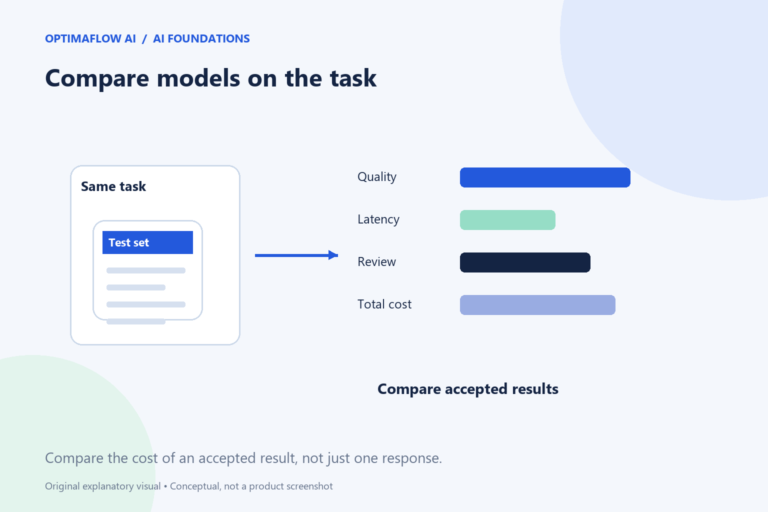
A model choice becomes easier when the task and success criteria are narrow. You may need a short internal summary, a structured extraction, or a draft that requires substantial review. Those jobs can have different requirements. This guide offers a task-based comparison method without pretending that one model is the best choice for every workflow.
Define the job and its constraints
State the input type, typical length, expected output, acceptable response time, and consequences of a mistake. Include whether the workflow needs images, structured data, or a particular integration. A model that writes appealing prose may still fail your extraction format.
Separate essential requirements from preferences. If a service cannot satisfy your data-handling rules or app connection requirements, a good sample answer does not make it suitable. Start by excluding incompatible choices rather than collecting a long list of vendors.
Use the same representative test set
Prepare fictional or approved examples that cover ordinary work and difficult cases. Use the same instructions and expected outcomes for each candidate, while recording any service-specific settings. Do not compare a carefully tuned prompt for one model with a vague request for another.
Score factual fidelity, completeness, format, and escalation behavior separately. The ability to say “information missing” can be valuable. A model that fills every field confidently may be worse for the task than one that flags uncertainty correctly.
Measure total effort and cost
Record response time, reviewer minutes, retries, and failures. Include usage charges and any platform subscription required to reach the model. Vendor pricing can change, so verify the current terms rather than copying a number from an old comparison.
Consider a fictional extraction task: one candidate is cheaper per response but requires more corrections. Another costs more per call but saves review time. Calculate the full cost per accepted result. Our cost planner can help compare the assumptions, but it cannot replace observed pilot results.
Test operational behavior
Inspect how the service handles timeouts, rate limits, invalid output, and unavailable capacity. Define whether the workflow retries, asks a person, or pauses. Check what logs are available without storing unnecessary sensitive content.
Make the model replaceable where possible. Keep the task brief and output requirements in documentation rather than burying them in an undocumented setup screen. A future service change should not require reconstructing the purpose of the workflow from scratch.
Choose and set a review trigger
Select the candidate that meets your minimum requirements with acceptable total effort. Record why it was chosen and what evidence supported the decision. Avoid a ranking based on a single response or an unrelated benchmark.
Review the choice after a major model update, a change in input volume, or repeated quality failures. Start with our prompt test method, then use the results guide to compare the workflow with its baseline.
Example: comparing accepted summaries
Two candidate setups process the same fictional ten-enquiry sample. Setup A produces responses quickly, but reviewers correct several invented details. Setup B takes longer to respond but preserves missing values more consistently. Record response time and correction minutes separately.
Calculate total effort for the accepted outputs, including failed attempts. If Setup B still takes less combined time, its slower response may be acceptable. If the task is interactive, latency could matter more. State the business tradeoff rather than declaring one model universally superior from a small sample.
Do not overread the pilot
A small test supports a narrow choice for a defined task. It does not establish that the selected model is best for all writing, coding, support, or business decisions.
Frequently asked questions
Should I always use the newest model?
No. Test the actual task and check current availability, controls, cost, and output quality. A release date alone is not a task-specific evaluation.
Are public benchmarks enough?
They can provide context, but your input, review requirements, and integrations may differ. A representative pilot is still useful.