How to Plan Safe Retries When a Workflow Step Fails
Distinguish temporary failures from invalid inputs, check uncertain outcomes, and set bounded retries with a human recovery route.
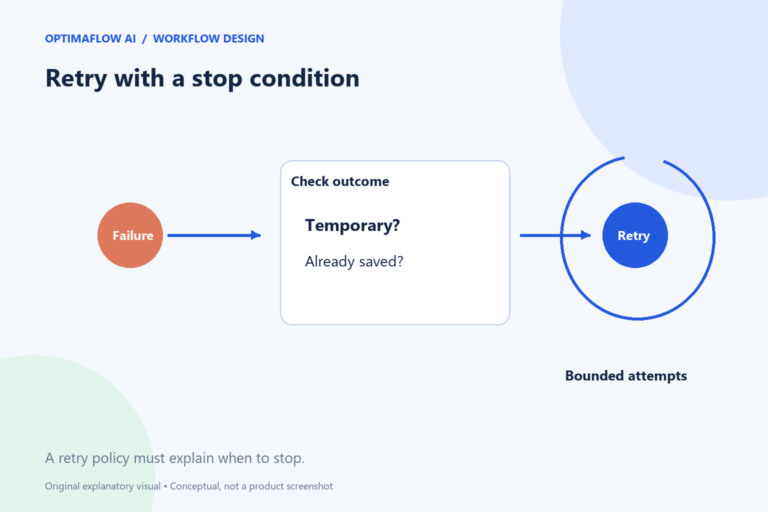
Retrying can recover a temporary problem, but it can also repeat a bad request or duplicate an action. A retry policy should explain which failures are eligible, how often to try, and when a person must inspect the result. It should not be a loop that keeps going until something happens.
Separate failure types
A temporary service outage differs from an invalid field or missing permission. The former may recover later; the latter usually needs a correction. Record the error category and affected step rather than treating every failure as the same event.
Read the service’s current error guidance where available. Some responses indicate a wait period or rate limit. Repeating the request immediately can worsen the problem. If the input is invalid, move it to a review queue with a concise explanation.
Define limits and spacing
Choose a maximum number of attempts and a maximum time window appropriate for the task. Space attempts according to the service’s requirements and supported platform behavior. An indefinite retry loop can create costs and hide a persistent failure.
Record each attempt without copying unnecessary private payloads into logs. After the final allowed attempt, set a clear failed or needs-review status. A record should not remain silently “in progress” forever.
Inspect actions with uncertain results
If a create request times out, first check whether the destination created the post, task, or record. Do not infer failure only from the missing response. Use a stable source reference or supported idempotency mechanism to reconcile.
For consequential actions, pause for a person when the result cannot be established safely. The cost of a delayed reply may be lower than the cost of sending the same commitment twice. This is a business decision that should be explicit in the process.
Keep failure context useful
A recovery item should identify the workflow, source reference, failed stage, time, and action needed. Include enough context to investigate, but avoid exposing secrets or sensitive full records in an alert.
Assign an owner and define whether the person corrects the input, reauthorizes the service, or confirms the destination state. “Something went wrong” is not a workable recovery instruction. Keep a link to the execution view when the platform supports it.
Test both recovery and stopping
Use fictional input and an appropriate test setup to observe a temporary failure, a validation failure, and an uncertain response. Confirm that the workflow stops at its limit and produces a review item. A retry policy is incomplete if only the successful recovery is tested.
Review costs and queue volume after the pilot. Repeated retries may indicate a deeper design issue. Use our duplicate guide and cost planner to make these consequences visible.
Example: temporary versus invalid failure
A temporary service-unavailable response may be eligible for a later bounded retry. A destination rejecting a required field needs a corrected input. Repeating that invalid request wastes attempts and may obscure the real cause.
For a timeout after a create request, inspect the destination before choosing either route. It may have completed the action. Your recovery record should explain which state is known and which remains uncertain, so the maintainer does not repeat work blindly.
Do not hide persistent errors
A workflow that eventually succeeds after many retries may still be unreliable and expensive. Track retry frequency and accepted-result cost rather than reporting only successful final runs.
Frequently asked questions
Should every failed step be retried?
No. Invalid input, authorization problems, and uncertain consequential actions need appropriate correction or inspection.
What is the best retry count?
There is no universal count. Follow service guidance and choose a bounded policy based on the task’s urgency, cost, and consequences.